
Quality managers face the ongoing challenge of identifying and reducing food safety risks at the onset of each year. Understanding where risk visibility depends on escalation is often the first step toward reducing surprises later in the year.
At the start of the year, quality managers are expected to confirm that key food and feed safety risks are understood, controlled, and auditable (Q1 planning). Audit plans are set, supplier scopes are reviewed, and testing programmes are often locked in months ahead. Yet in many organisations, risk visibility remains fragmented. Supplier documentation, testing data, regulatory limits, and incident history often sit in separate systems, making it difficult to see emerging issues before they escalate. In this context, many teams rely on external signals, such as recalls or regulatory alerts, to surface risk. While these tools are valuable, they are reactive by design. When an alert appears, the underlying issue has already occurred.
The familiar set of hazards highlighted by RASFF
One of the most visible examples of this dynamic is the EU’s Rapid Alert System for Food and Feed (RASFF). RASFF enables authorities to rapidly exchange information when a food or feed product presents a risk to human or animal health. This rapid communication allows regulators to take action, such as withdrawing products, blocking imports, or initiating recalls. Across food and feed supply chains, RASFF notifications consistently highlight a familiar set of hazards, including:
• Pesticide and drug residues
• Foreign objects
• Mycotoxins
• Allergens
• Genetically modified organisms (GMOs)
• Heavy metals
• Dioxins, PCBs, and PAHs
• Pathogenic bacteria
Recent alerts of aflatoxins, GMOs and pesticides
In 2026, 32 aflatoxin-related notifications were recorded in the RASFF portal. Most cases involved dried figs (7 notifications) and pistachio nuts (6 notifications). Analysis of the countries of origin shows that the majority of RASFF alerts concerned products originating from Turkey, the United Arab Emirates (UAE), and the United States (USA). For GMOs above the regulatory limits, the European Commission had 1 notification this year, which concerned GMOs above the limits found in polenta from Italy. As of 2025, a total of 9 notifications concerning GMOs have been registered via RASFF. 31 RASFF notifications were made in January 2026, naming exceeding pesticides residues in fruits and vegetables and some unauthorised pesticides found in products like tea, peppers and beans.
Why are we often too late with common hazards?
The hazards listed above are not new. Their recurrence reflects known risk profiles linked to specific commodities, production conditions, but also country of origin (Figure 1).
Figure 1 – Country of origin for RASFF notifications* concerning aflatoxins, GMOs and pesticides.
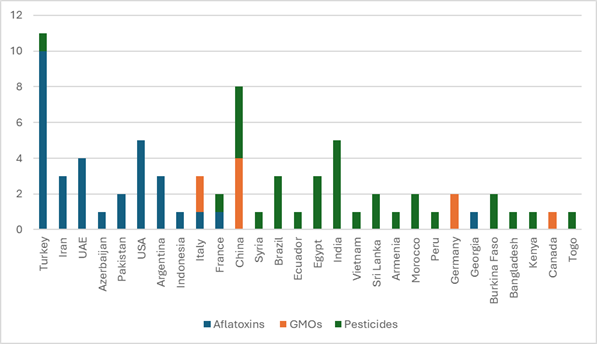
*Alerts mentioned in this graph for aflatoxins and pesticides concern time frame: Jan 1 – Feb 12, 2026. Alerts for GMOs concern time frame: Jan 1, 2025 – Feb 12, 2026..
From a system-level perspective, repeated alerts for well-understood hazards raise an important question: If these risks are known, why are they still being detected so late? Risk notification are important, but early detection, including internal risk viability, supplier oversight remains key in safeguarding food safety and prevent escalation. By the time a RASFF notification is issued, contamination or non-compliance has already been detected, often after products have entered the supply chain.
A recent example is the contamination of infant formula products distributed across more than 60 countries, including the EU, due to potential presence of Bacillus cereus and its toxin, cereulide. The issue was traced back to a contaminated arachidonic acid (ARA) oil supplied by a third-party manufacturer. RASFF notifications highlighted the risk of vomiting and diarrhoea in infants, triggering a major international recall and leaving the companies involved with the challenge of restoring consumer trust. Some years ago (1999), we experienced the major dioxin crisis in Belgium and the Netherlands, linked to contaminated animal feed. This scare caused widespread disruption to eggs, dairy, pork, and beef supply across Europe. Supermarket shelves were emptied, exports were halted, and confidence in the food system was shaken.
Translating risk intelligence to better internal controls
RASFF helped limit the damage in both the infant milk and dioxin scare, and many others. But in each instance, the alert marked the point of escalation, not prevention. Common hazards such as mycotoxins, pesticide residues, and unauthorised GMOs continue to surface year after year, often linked to the same commodities or sourcing regions. This suggests that while risks are broadly understood, risk intelligence is not always translated into consistent internal controls. At plant level, this gap often becomes visible in how testing, sampling, or release decisions are made. Based on risk intelligence, quality managers can for example decide to increase testing frequency or place the material under temporary release hold. Below 2 scenarios that illustrate how RASFF insights can inform internal decisions, before issues escalate externally, when they are interpreted as risk signals rather than incident reports.
Scenario 1: Adjusting testing frequency for aflatoxins
A food manufacturing site sourcing dried fruit observes repeated RASFF notifications for aflatoxins in similar products from specific regions. Rather than treating these as isolated events, the quality team:
- Flags the origin as temporarily higher risk
- Increases incoming lot testing frequency for aflatoxins
- Tightens review of supplier documentation during that period
The alerts do not indicate a failure at the site, they trigger a preventive adjustment to reflect elevated external risk.
Scenario 2: Holding release pending targeted verification
A feed production facility monitors RASFF notifications related to unauthorised GMOs in maize-based materials. When a shipment arrives from a region linked to recent alerts, the facility:
- Places the material under temporary release hold
- Performs targeted GMO testing beyond routine screening
- Confirms supplier declarations align with current regulatory thresholds
The hold is applied not because of detected non-compliance, but because external alerts indicate increased uncertainty that warrants verification before release.
Preparing quality managers for 2026 and beyond
Many quality managers use the start of the year to pressure-test whether their current systems would surface high-risk issues before they escalate externally (Q1 planning). A simple place to start is reviewing how testing data, supplier information, and regulatory thresholds are connected, and where visibility still depends on external alerts. RASFF plays a critical role in protecting public health. But when alerts become the primary source of risk awareness, they often signal disconnected internal systems rather than unexpected hazards (testing becomes reactive, supplier issues surface late, audits require more remediation and external alerts replace internal confidence)
Early-year decisions shape the entire compliance cycle. Understanding where risk visibility depends on escalation is often the first step toward reducing surprises later in the year. With more than 25 years of experience, supported by advanced technology and expert services across the global food supply chain, FoodChain ID is uniquely positioned to help address these challenges. We help you assess whether your current risk monitoring is preventive or reactive.
Contact us to learn more about how we can support your specific needs.