


By Kathy Van Zyl, Regulatory Consultant
Stay informed on regulatory developments and emerging sustainability trends. Subscribe to Regulatory Trends for timely insights into global regulatory compliance changes.
The European Deforestation Regulation (EUDR) introduces a transformative compliance landscape for the global food industry. Coming into effect on December 30, 2025 for large and medium-sized companies and December 30, 2026 for small and micro enterprises, this regulation requires businesses trading within the European Union to provide verifiable traceability records proving that commodities are sustainably sourced and not linked to deforestation.
Commodities Covered Under the EUDR
The EUDR affects seven key agricultural commodities and their derived products: cattle, cocoa, coffee, palm oil, rubber, soya, and wood. Each of these plays a crucial role in global supply chains, particularly within the food, beverage, and agro-industrial sectors. Businesses sourcing or trading in these commodities must demonstrate full supply chain transparency from origin to point of entry in the EU market.
Recently Proposed Adjustments to Compliance Timelines
- Large and Medium Operators: Continue compliance from 30 December 2025.
- Micro and Small Operators: Application deferred to 30 December 2026.
- Competent Authorities’ enforcement: Begins 30 June 2026 (for large) and 30 December 2026 (for small operators).
Global Legislative Momentum Toward Deforestation-Free Supply Chains
While the EUDR represents the EU’s most significant regulatory step toward sustainable sourcing, similar legislation is emerging worldwide. Governments are increasingly aligning policies to curb deforestation, mitigate greenhouse gas emissions, and promote responsible land management.
- United States – The Combating Global Deforestation Act, introduced in late 2024 in a previous Congress, promotes ecosystem restoration and responsible sourcing.
- Australia – The Illegal Logging Prohibition Act, amended in 2025, strengthens international due diligence requirements.
- Japan – The Revised Clean Wood Act, fully enacted in April 2025, enhances monitoring of wood imports.
- China – Green Supply Chain Policies, originally introduced in 2016, continue to advance corporate decarbonization.
- Brazil – The Brazilian Forest Code, continuously updated since 2012, integrates automation and technology for monitoring compliance.
- South Africa – The Management Control System Regulations (2025) will become fully operational by September 2026, integrating recognized international sustainability frameworks.
As emphasized by the Greek Minister of Rural Development and Food in October 2025: “The challenge in today’s era, when unpredictable crises follow one another, is to ensure food sufficiency — a decisive factor in ensuring social cohesion and normality.”
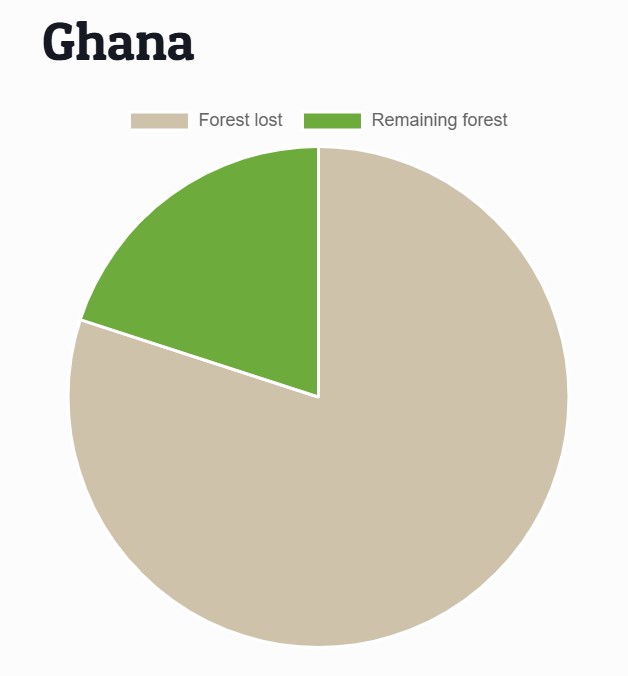
Source: International Wildlife Conservation Forest loss in Ghana over the last 60 years
Organic vs. Sustainable: Understanding the Regulatory Difference
Many food producers are familiar with organic certification, but sustainability and deforestation compliance expand beyond the boundaries of organic principles. Understanding this distinction is essential for companies managing cross-border trade and compliance documentation.
Organic refers to a product certification that assures consumers that specific methods ‒ such as the exclusion of synthetic chemicals and GMOs ‒ were used in production. Certification is typically monitored by government and third-party certification bodies. Examples include the United States Department of Agriculture or the European Union organic programs.
Sustainability, by contrast, refers to broader business practices that are environmentally responsible, socially equitable, and economically viable. This includes optimizing local resources, reducing transportation emissions, and supporting community well-being.
Cocoa as a Central Example of EUDR
Cocoa production illustrates the complexity of sustainability compliance. Chocolate originates from pods grown on cocoa trees within the ‘cocoa belt,’ primarily in West Africa. Deforestation, extreme weather, and disease outbreaks have jeopardized both the quality and quantity of cocoa beans. As a result, the cocoa sector has become a focal point of sustainability and traceability enforcement.
Under the EUDR, by December 30, 2025, large cocoa suppliers must prove their beans are not linked to deforestation or illegal land clearing. Tools like satellite mapping, GPS verification, and digital traceability platforms are being deployed to ensure compliance. These technologies support transparency, reduce fraud risk, and strengthen supply chain resilience.
Strategic Implications for Food and Beverage Manufacturers
For food industry professionals, sustainability compliance is now an operational and reputational imperative. Beyond legal compliance, companies must navigate rising costs due to inflation and supply constraints ‒ factors compounded by regulatory change. Integrating sustainability strategies early reduces exposure to enforcement risks and enhances brand competitiveness.
Manufacturers are advised to conduct supplier audits, implement geolocation data collection, and collaborate with verified partners to ensure EUDR-aligned sourcing. Leveraging traceability platforms ‒ such as FoodChain ID’s deforestation-free compliance management solutions ‒ can streamline documentation, validation, and continuous monitoring of sustainability requirements.
Conclusion Regarding EUDR
Deforestation laws such as the EUDR aim to cut greenhouse gas emissions, protect ecosystems, and preserve biodiversity. For food manufacturers and ingredient suppliers, proactive adaptation will not only ensure compliance but also strengthen long-term supply chain resilience. As sustainability becomes a market differentiator, now is the time to invest in traceable and responsible sourcing systems.