


Climate change is said to be spiking the spread, prevalence and severity of mycotoxins in food and feed crops. For quality managers, this sparks the demand for more actionable information to safeguard feed and food safety.
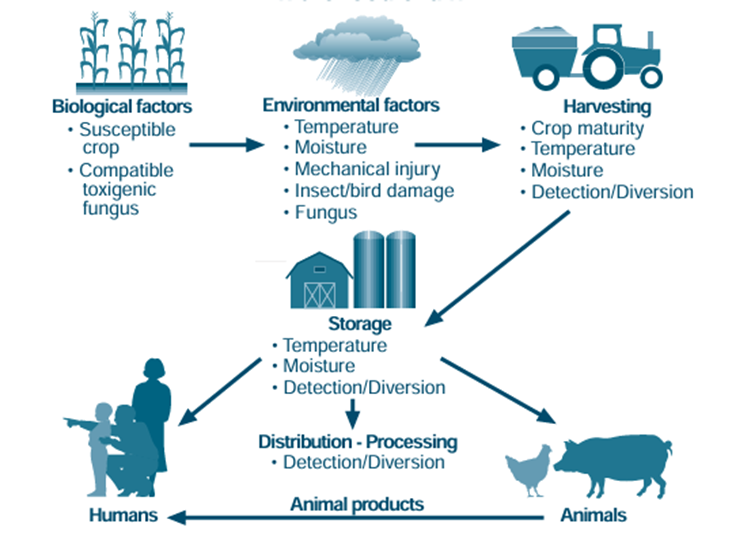
The occurrence of fungal and subsequently, mycotoxin contamination in crops is of major concern since it has significant implications for food and feed safety, livestock health and productivity, food security and international trade. Mycotoxins are naturally occurring toxins produced by certain moulds (fungi) that grow on a variety of different crops and foodstuffs including cereals (wheat, barley and corn), nuts, spices, dried fruits, apples and coffee beans. These moulds often grow under warm and humid conditions and can growth can occur either before harvest (such as Fusarium) or after harvest, during storage (such as Aspergillus and Penicillium species), on/in the food itself. Consequently, mycotoxin contamination may arise at any stage throughout the food production chain (Figure 1).
Figure 1 – Mycotoxin contamination can occur at any point in the food and feed production and supply chain (Source: CAST, 2003).
Severe effects in animals and humans
Although more than 300 mycotoxins have been identified, only six (aflatoxins, trichothecenes (including deoxynivalenol and T-2 toxin), zearalenone, fumonisins, ochratoxins, and patulin) are routinely found in food and feed. It is important to consider that often mixtures of mycotoxins can be found in foods and feeds, especially in cereals. The co-occurrence of mycotoxins can affect both the level of mycotoxin production and the toxicity of the contaminated material. Also masked mycotoxins (also known as ’emerging mycotoxins’ or ‘modified mycotoxins’) is a growing threat. Masked mycotoxins are metabolites that are formed by the original mycotoxins due to a form of processing, This can include food processing for example.
Animals can be exposed to these toxins through ingestion, inhalation, or skin contact. Under field conditions, the symptoms of mycotoxin-induced toxicity in animals range from reduced productivity, immunosuppression, heightened disease susceptibility, and, in several cases, death. Humans are primarily exposed to mycotoxins by consuming contaminated crops such as grains, nuts, and fruits. Also milk can be contaminated by aflatoxin M1 (metabolically produced in the udder when cows ingest feed that is contaminated with aflatoxin B1). Exposure to contaminated food can cause a wide range of health problems, from acute illness to chronic conditions including cancer, immune suppression, kidney damage, and neurological disorders.
Increased risk due to climate change
Although numerous prevention and control measures are in place to reduce the risks posed by mycotoxins, these risks persist, and may even intensify, due to climate change. The European Environment Agency reports that climate change influences fungal behaviour and geographic distribution, increasing the likelihood of exposure to mycotoxins. Extreme weather events, including heavy rainfall and prolonged droughts, place plants under additional stress, making cereals (particularly corn) more susceptible to fungal infections and subsequent contamination, which can lead to large batch variabilities int terms of contamination levels and quality in general.
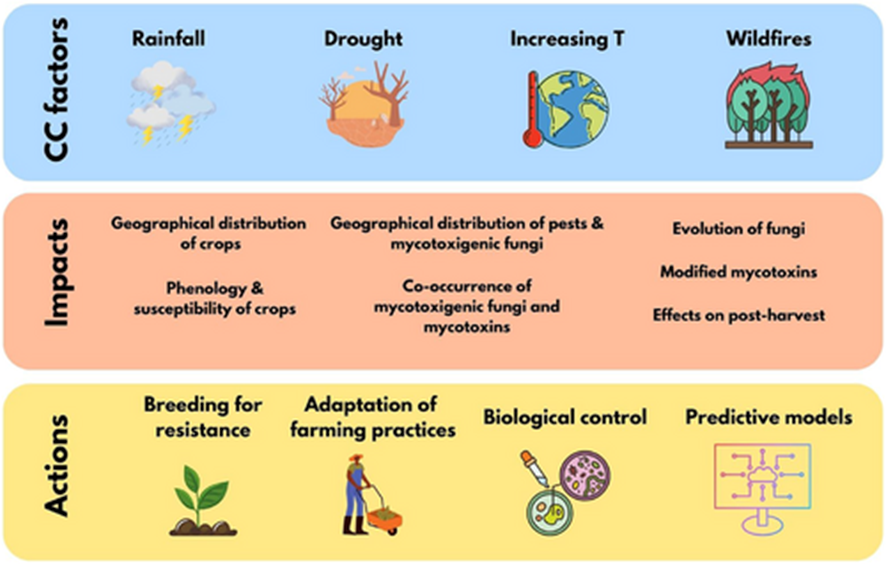
Moreover, increased precipitation, flooding, and soil erosion can facilitate the movement of mycotoxins from soil into rivers and groundwater, altering their spread. A study in Serbian maize (2021-2023) demonstrated that temperature, humidity, and rainfall during both the growing and harvest seasons strongly influenced mycotoxin levels, with the most severe contamination occurring under specific climatic conditions. Notably, the highest mycotoxin levels, like aflatoxins, were linked to warmer temperatures and lower rainfall (Penagos-Tabares et al, 2025). A comprehensive literature search of available studies in the scientific literature published between 2000 and 2023 (Casu et al, 2024) showed a logical framework defining the climate change (CC) factors, the effects that they exert on crops and mycotoxigenic fungi, together with the strategies available to counteract mycotoxin contamination (Figure 2).
Figure 2 – The Climate Change (CC) factors, the impacts and actions needed (source: Casu et al, 2024).
Quality managers: Re-assessing risk management
To ensure food and feed safety, maximum and guidance limits for mycotoxins in specific food and feed products have been established internationally such as by the FAO and WHO in the Codex Alimentarius (general standard for contaminants and toxins in food and feed). These limits are informed by scientific research on toxicity, exposure levels, analytical capabilities, and the economic impact of enforcement. In the European Union (EU) the maximum levels for human food are published in the European Contaminants Regulation (EU) 2023/915. This regulation has been updated in 2024 and simplifies the complexity of mycotoxin regulations by summarizing and updating all mycotoxin maximum levels for food matrices. For livestock feed ingredients and complete feed in the EU, maximum levels have been outlined primarily in Directive 2002/32/EC.
Quality managers play a key role in early detection and prevention of mycotoxin issues. As conditions change, quality and assurance teams must continually review their actions to ensure regulatory limits are met and feed and food safety are maintained. Quality managers can address increasing mycotoxin risks by:
- Reassessing sampling protocols (frequency, analytical methods, factory-gate testing) and implementing finished-product verification.
- Using agronomic data and crop surveys to monitor short, medium and longer term risks by commodity and region.
- Using supplier scorecards that track performance, mycotoxin levels, and compliance with food-safety requirements to identify high-risk suppliers and commodities.
Staying up to date on regulatory changes (e.g., amendments to EU Regulation 2023/915) or outsourcing regulatory monitoring and advisory to a qualified external party.
| Example on how to effectively manage potential mycotoxin risk A paper by Baker et al. (2014) outlined an example how risk assessment led to certain an appropriate tactical response by quality managers. 1. Crop and agronomic data indicated that the 2012 U.S. corn crop would have elevated aflatoxin levels, especially in the Midwest and Southeast. 2. Supplier quality assessments showed that only some suppliers in the North and Northwest could meet food-safety specs, and their supply would not meet production demand. 3. A mycotoxin management plan was implemented across the U.S. production network, including intensified testing of all inbound corn loads for aflatoxin. 4. Facilities sourcing from higher-risk regions (Midwest and Southeast) placed all finished product on positive release until test and audit results confirmed compliance with food-safety requirements. Compared to 2011, this represented a 100% increase in overall testing and a 25% increase in held product pending positive release. |
Preparing quality managers for 2026 and beyond
Managing mycotoxins and is an ongoing challenge for quality managers, intensified by climate change. As conditions shift, mitigation strategies must be reassessed, and tools such as risk mapping, predictive models, supplier data, and proactive planning become increasingly important. This requires a good and trusted partner with the right expertise.
With over 25 years of expertise, technology, and services supporting the global food supply chain, FoodChain ID is uniquely positioned to help you navigate regulatory compliance. Our Regulatory Limits solution provides comprehensive access to current, pending, and proposed contaminant limits. Updated and supported by a team of global regulatory analysts, this resource covers regulations for more than 90 contaminants, including mycotoxins, across over 100 countries.
Combined with tailored support, our solution enables quality managers to proactively monitor compliance and stay ahead of evolving regulatory requirements. As mycotoxin risks continue to rise in 2026 and beyond, we are here to help you ensure your products remain safe and compliant. Contact us to learn more about how we can support your needs.