


Due diligence assessments of high-risk suppliers, reviews of supply chain documentation, and audits are just some of the requirements involved in complying with the EU deforestation rules. Ongoing postponements of the regulation’s implementation have only increased the demand for clarity and guidance among quality managers.
Global deforestation is often driven by the expansion of agricultural land for commodities such as palm oil and soy, many of which are ultimately consumed in Europe. This deforestation has serious environmental and social consequences, including biodiversity loss, climate change, and the displacement of Indigenous communities.
To address deforestation linked to EU consumption of cocoa, coffee, palm oil, soy, wood, rubber, and cattle products, the European Union adopted Regulation (EU) 2023/1115 on 19 April 2023. Commonly known as the EU Deforestation Regulation (EUDR), it seeks to reduce the EU’s contribution to greenhouse gas emissions and biodiversity loss. The Regulation applies to any operator or trader that places EUDR-covered commodities, or their derived products, such as beef, furniture, or chocolate, on the EU market or exports them from the EU.
Extra layer of work for quality managers
For quality managers, working in the food and feed supply chains, the EUDR significantly changes day-to-day decision-making and expands their responsibilities. In practice, quality managers are increasingly drawn into sustainability discussions within their organisations, even when this is not part of their formal role. They can also expect a growing number of requests for evidence that supply chains are deforestation-free, particularly for soy and other high-risk commodities such as palm oil and cocoa. In effect, while quality managers already carry a substantial burden related to audits and supplier oversight for raw materials, the EUDR adds yet another layer of compliance to manage.
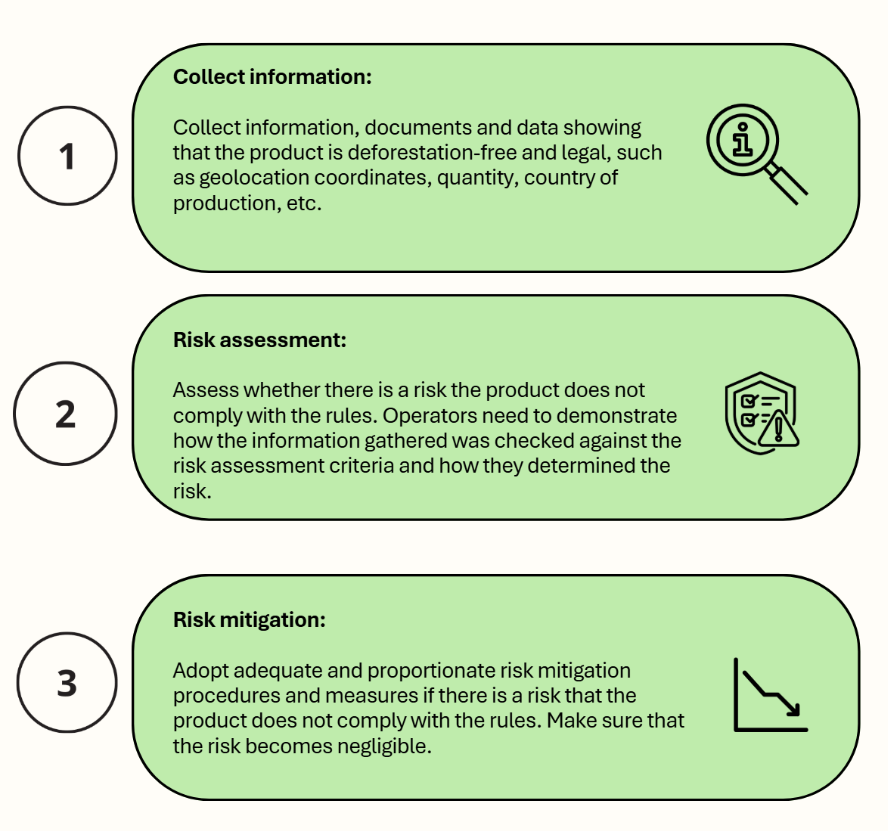
Evidence comes from implementing robust due diligence processes for EUDR-listed products to ensure they are deforestation-free, legally produced, and fully traceable, down to the production plot through geolocation data. Failure to comply may result in fines of up to 4% of annual turnover, as well as risks of market exclusion, blocked or seized shipments, and reputational damage. As a general rule, operators will have to set up and maintain a Due Diligence System, in accordance with Art. 12 of EUDR, for each of their suppliers. The exercise of due diligence consists of three steps (Figure 1).
Figure 1 – Collect, assess and mitigate. The three steps of due diligence, the core of EUDR (source: EC).
Example: Soybeans for feed and food use
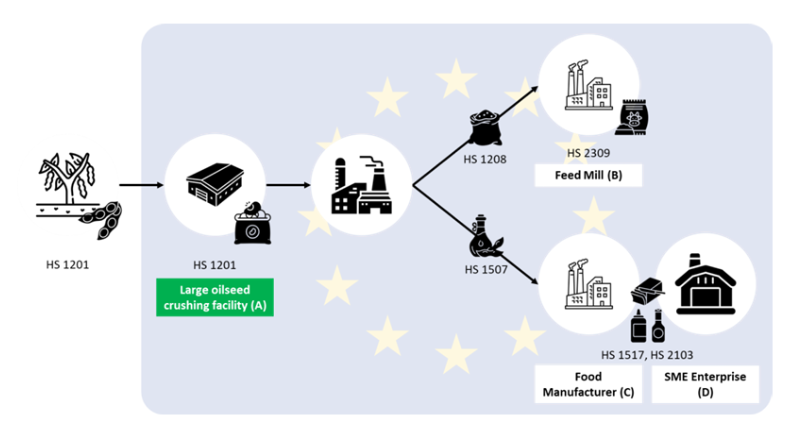
As we all know, food supply chains can be long and complex, but does this mean that every party in the chain is responsible for due diligence under the EUDR? Not necessarily. In a report by the European Commission, different scenarios are outlined for various commodities. For soy, an important ingredient in compound livestock feed and certain food products, the report explains the following scenario (outlined in Figure 2). A large non-SME oilseed crushing facility (A) imports soybeans into the EU for the first time and is therefore an upstream operator under the EUDR. It must carry out full due diligence to ensure the soybeans are deforestation-free and legal, and submit a due diligence statement in the Information System.
Facility A then processes the soybeans into soymeal and soy oil, both of which are relevant products under the EUDR. In doing so, it becomes a downstream operator. Because these products are made from soybeans that have already undergone due diligence, facility A can submit due diligence statements for the soymeal and soy oil by referencing its existing statements. However, if additional soybeans not previously covered by due diligence are used, full due diligence (including geolocation data) must be carried out for those inputs. The soymeal is sold to a feed mill (B), which uses it to produce compound livestock feed. Since compound feed is not a relevant product under the EUDR, feed mill B has no EUDR obligations. The soy oil is sold to a non-SME manufacturer (C) and an SME enterprise (D), which refine the oil and produce food products such as margarine and sauces that are not listed in Annex I. As these products are not relevant under the EUDR, manufacturers C and D are not considered operators or traders under the Regulation and therefore have no EUDR obligations.
Figure 2 – Scenario for the supply chain for soy (source: EUDR compliance report EU, 2025).
More time for roll-out and revision of rules
Although the EUDR was adopted by the European Commission (EC) in 2023, implementing its requirements across today’s complex global supply chains takes time. In 2025, it has become clear that many businesses face significant challenges in putting the required due diligence measures in place by 30 December 2025. In response to pressure from EU and non-EU countries, global trading partners, and industry stakeholders, the European Commission agreed to revise the Regulation to ensure that implementation is more practical and workable for companies. The revised version, adopted in December 2025 and published in the Official Journal of the European Union, grants businesses an additional year to comply with the new EU rules aimed at preventing deforestation.
Large operators will have to apply the regulation from 30 December 2026, and small operators (private individuals and enterprises with under 50 employees and an annual turnover related to the products concerned of less than €10 million) from 30 June 2027. In addition to this, the EC also simplified the (registration) of due diligence statements or -declarations among other things. The agreed amendments will reduce the data load on the IT system so that it is capable of handling the expected due diligence statements and simplified declarations submitted by all operators. It is not the first time that the EUDR implementation has been delayed with a year. It was originally set to kick off on December 30, 2024.
Preparing quality managers for 2026 and beyond
In conclusion, despite multiple delays in the implementation of the EUDR, many companies already view deforestation and sustainable sourcing as strategic priorities. As a result, they have begun mapping their supply chains and integrating EUDR requirements into their business strategies to prepare for future compliance. While some companies, such as those with established “deforestation-free” commitments, are well advanced, others are still working through the complexities of implementation, which has contributed to the recent regulatory adjustments and postponement of the rules.
What do these changes mean going forward, and do the same requirements still apply when it comes to traceability, documentation, and supplier verification? With more than 25 years of experience in sustainability within the food industry, FoodChain ID is uniquely positioned to support food and feed manufacturers and brands in achieving regulatory compliance, while also advancing forest conservation and a healthy planet.
Our Deforestation-free Services combine supply chain due diligence with compliance verification, helping you navigate this complex new regulation and ensure your products remain safe and compliant. Get in touch with us to learn more what we can do for you.