

GFSI certifications are standardized. The experience of earning one is not.
If your organization holds a Global Food Safety Initiative (GFSI) certification, whether SQF, BRCGS, FSSC 22000, or another recognized scheme, the standard itself is consistent. The requirements are the same regardless of which certifying body delivers the audit. So it is easy to assume that all certifying bodies offer essentially the same thing.
They don’t. For quality leaders managing multi-site food and beverage operations, what a certifying body offers beyond the scheme itself shapes both the audit experience and the operational value. And as quality teams take on more responsibility across larger portfolios, those differences matter more than ever.
A Shift to Strategic Certification
Two key industry shifts are increasing the operational and strategic demands on food and beverage Quality leaders:
- Distribution channel requirements are expanding beyond GFSI. Major retailers and brand customers are layering their own inspection addendums on top of GFSI certification. For example, Costco, McDonald’s, and McCormick all maintain proprietary requirements that must be coordinated in addition to your GFSI audit program. Managing these additional expectations adds complexity that a certifying body either absorbs or passes back to your team.
- Food industry consolidation is expanding quality responsibilities. Quality functions are now responsible for larger, more complex portfolios of facilities. Centralized supplier governance and multi-site operations place higher pressure on certifying bodies to deliver consistent, category-appropriate expertise at scale.
Together, these shifts mean that the certifying body you choose directly affects how much time your quality team spends on certification logistics versus food safety improvements. A certifying body that can absorb the growing complexity of retailer addendums, coordinate across a multi-site portfolio, and offer category expertise and insights can make the difference between a functioning quality program and a leading one. That makes choosing a food safety certification body a strategic decision rather than a commodity purchase.
The Generalist Trade-Off
Many certifying bodies service food and beverage alongside multiple other industries, from medical devices to automotive manufacturing. When food is one practice area among many, some structural limitations may follow.
Auditor bench depth can be a constraint. Within each GFSI scheme, auditors are further qualified by category: bakery, meat, dairy, pet food, packaging, and others. Schemes also require rotation, meaning the same auditor cannot evaluate the same site indefinitely. A certifying body with limited category depth may struggle to provide qualified replacements consistently. For multi-site operations spanning multiple categories, this becomes a continuity risk.
Another risk is that when a certifying body manages food alongside other industries, food clients may compete for scheduling priority, auditor availability, and administrative attention. Scheduling and communication gaps can quietly accumulate, and quality teams end up spending time coordinating logistics that a more focused partner would handle end-to-end.
Cross-site visibility can also suffer. When a certifying body lacks specialization in food and beverage, it is less equipped to connect audit findings across your portfolio, identify recurring patterns, or surface trends that would help your quality team stay ahead of issues. In some cases, operations use multiple certifying bodies to cover different sites, creating further disconnect and making it harder to build a unified view of food safety performance.
The Specialization Advantage
When a certifying body works exclusively with food and beverage manufacturers, it is better positioned to eliminate these friction points. Auditor recruitment and training are concentrated on food categories, so bench depth exists where you need it and rotation does not become a continuity problem. Client service teams know your industry, your schemes, and your operational pressures, so coordination stays off your quality team’s plate. And because the food safety certification body works across food and beverage portfolios every day, it can connect findings between your sites and surface patterns that allow your quality teams to shape leading food safety strategy rather than just compliance records.
The result is a certification program that runs predictably in the background, freeing your quality team to focus on what matters: strengthening food safety performance.
Evaluate Your Certification Partner
If your quality team spends more time managing certification logistics than acting on audit insights, the issue may not be your team’s capacity. It may be your certifying body’s service model.
But how do you assess whether your current partner is structured for food and beverage? What questions should you be asking?
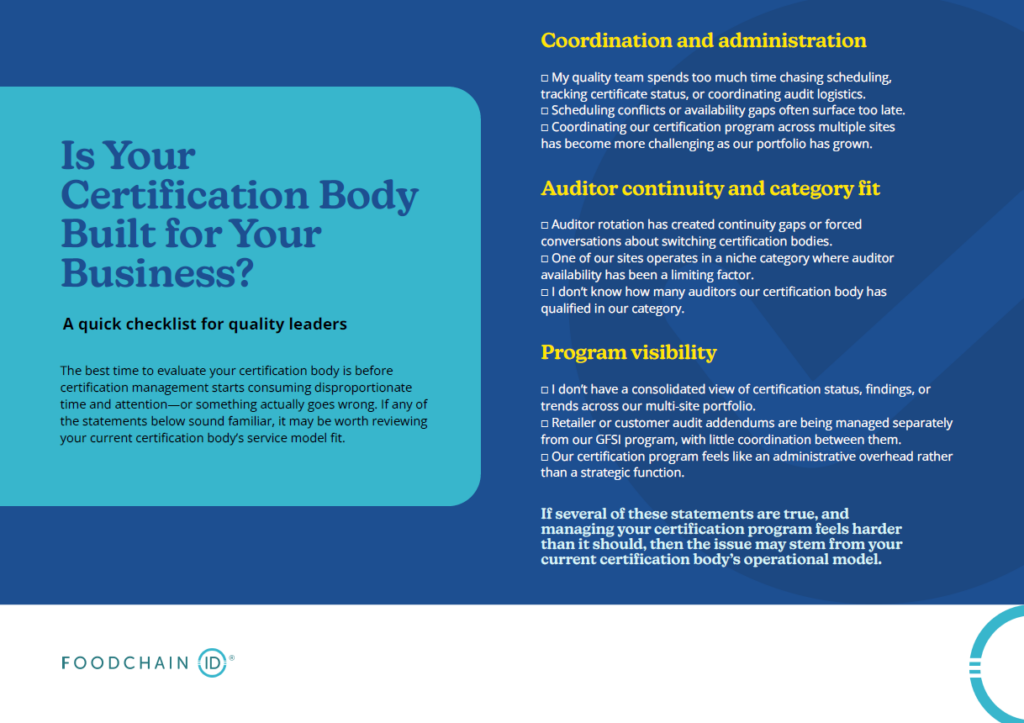
You can use our Certification Readiness Checklist offers a framework for evaluating both current and prospective food safety certification bodies against the criteria that matter for multi-site food and beverage operations.
Certification Readiness Checklist
Do you need more information?
Talk to a FoodChain ID specialist about building a more predictable food safety certification process for your operation.